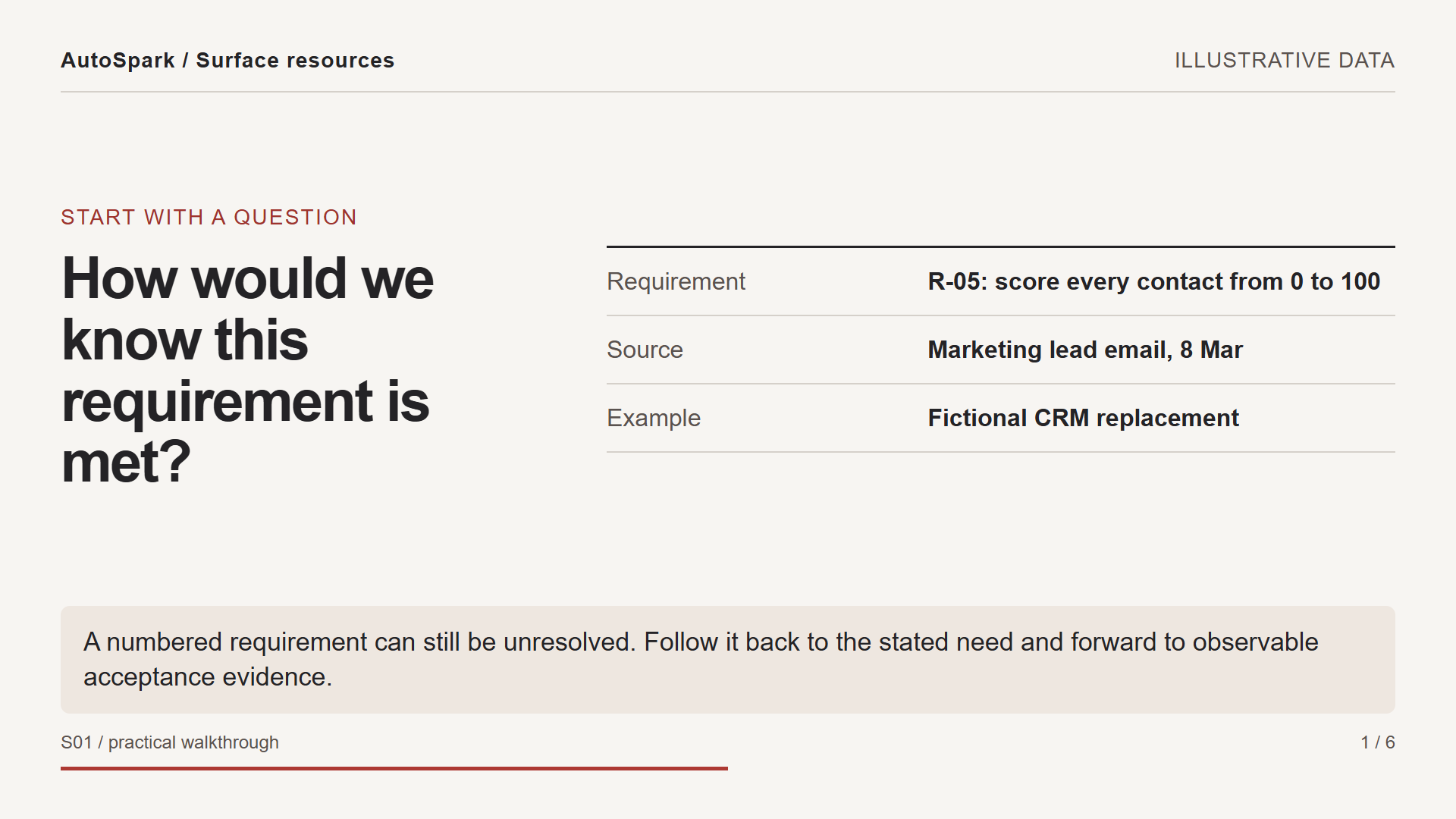
A BRD that leaves unresolved decisions visible
A business requirements document should explain the change people need, its boundaries and the evidence that will establish acceptance. Give each requirement a source and an accountable decision owner. Keep proposals separate from agreed requirements, and link detailed tests through a traceability matrix.
Use this document when a sponsor and delivery team need to agree what a change includes. It is an authored working template, not a mandated standard. The example below is fictional; adapt its fields to your organisation's approval process.
Copy this document structure
| Section | Fill in | Check before agreement |
|---|---|---|
| Decision and sponsor | What decision will this document support, and who can make it? | The named sponsor accepts responsibility |
| Current problem | Observed behaviour, dated source and affected users | Observation is separated from explanation |
| Desired outcome | What users should be able to do differently | Someone can demonstrate the outcome |
| Scope | Included work, exclusions and system boundaries | Exclusions have an owner and a reason |
| Requirements | ID, behaviour, source, owner, priority and status | Every agreed item has acceptance evidence |
| Constraints | Known limits and their sources | Assumptions are labelled and have a check date |
| Open decisions | Options, conflicting accounts and next evidence | No unresolved item is silently treated as agreed |
| Approval and changes | Version, decision, approver, date and change reason | Readers can identify the agreed baseline |
Worked example: a discount approval change
In this synthetic case, a sales lead asks for automatic approval up to 15%. A finance lead says the limit should stay at 10%. Both accounts are evidence of what those people requested. Neither establishes the authorised policy.
| ID | Proposed behaviour | Source | Status and next step |
|---|---|---|---|
| BR-01 | Route discounts above the authorised limit to a named approver | Workshop W-01, sales and finance accounts | Proposed; sponsor must confirm the policy source and threshold |
| BR-02 | Show the requester whether a decision is pending, approved or rejected | Synthetic support record T-01 | Proposed; operations owner to agree wording and exception cases |
| BR-03 | Retain the decision and its reason against the request | Workshop W-01 | Proposed; confirm access and retention requirements before design |
An acceptance example for BR-01 might be: given an authorised limit of 10%, a request for 11% reaches the designated approver and remains pending until a recorded decision. Test the boundary at 10% as well. These values illustrate a test; they do not prescribe a commercial policy.
Record whether rejected requests can be revised and who may act when the approver is absent. A successful happy-path demonstration leaves those exceptions untested.
Use the document in a review
Send the source references with the draft. Ask each owner to identify unsupported statements, missing exception cases and work outside the boundary. Record disagreement by requirement ID. After the authorised decision, preserve the prior version and explain what changed.
For the row-level links from request to test, use the requirements traceability matrix. A BRD explains the agreed change; the matrix follows individual requirements through their evidence. An agreed document still needs the organisation's separate delivery and release authorisations.
Which parts of this change are agreed, and which decisions remain open?
Agree scope, source-linked requirements and acceptance without concealing open decisions.
Your starting question: Which parts of this change are agreed, and which decisions remain open?
Start by checking
- Confirm the authorised scope and baseline.
- Trace each requirement to its source and acceptance owner.
- Keep unresolved threshold decisions visible.
Evidence to gather
- Current scope and attributed workshop notes.
- Requirement list and example acceptance cases.
Not established yet
- The authorised policy threshold.
- Whether the requirements cover every exception.