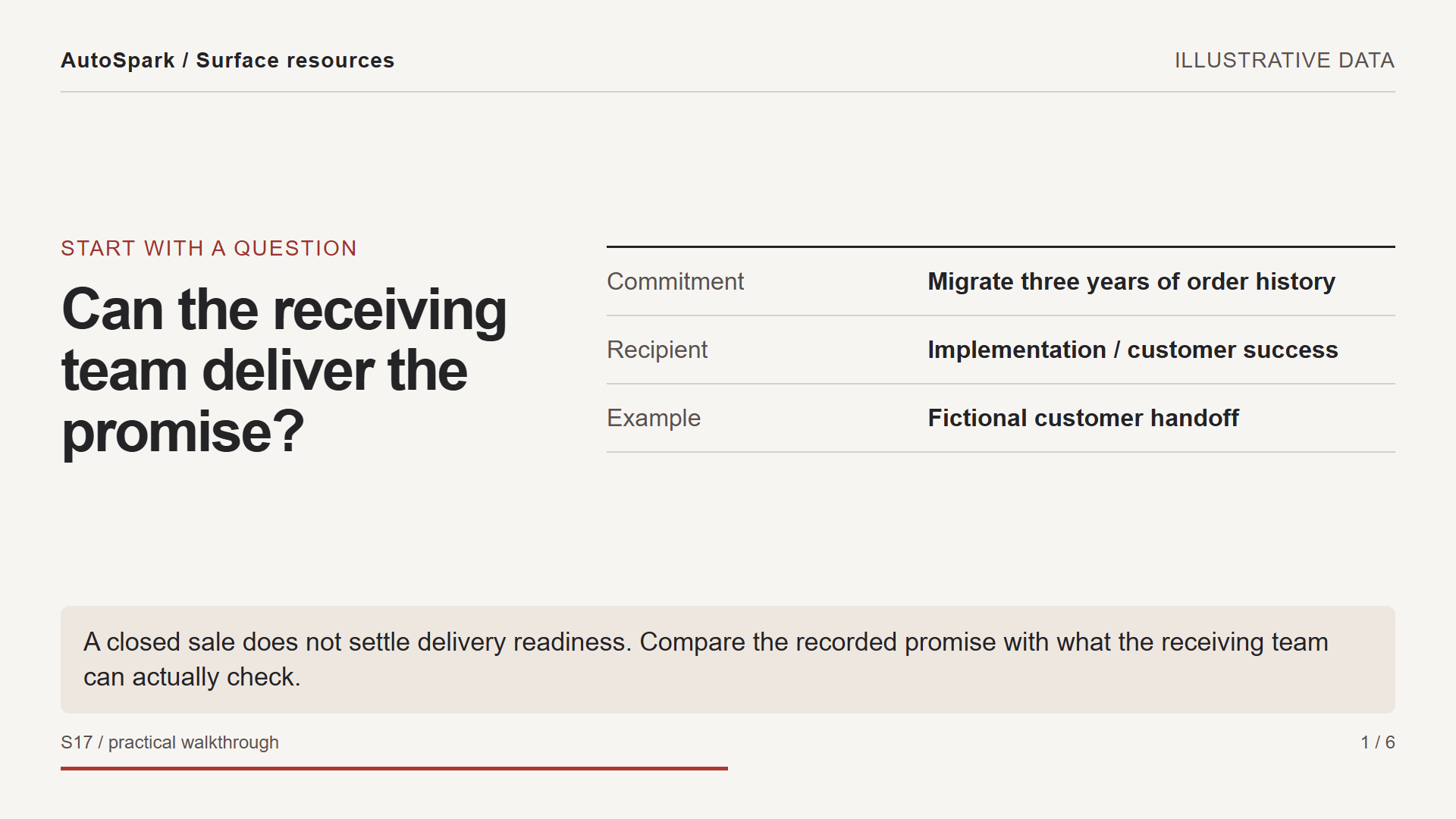
Write the disagreement as a checkable question
When two accounts disagree, preserve both accounts. Check whether they cover the same period and population, and whether the terms mean the same thing. Then identify the evidence that could distinguish them. Keep the decision unresolved when that evidence is missing.
The sales-to-customer-success handoff example contains an invented promise about three years of historical data and a note that the available export covers two years. The receiving team has marked the item Queried. The example does not establish what another system contains or what a contract legally requires.
Separate the kinds of claim
“Three years were promised” concerns a recorded commitment. “The export covers two years” concerns a particular technical record. Both statements might be accurate. The outstanding question is how the requested historical coverage will be supplied, or what decision is needed if it cannot be supplied.
Read the source wording before summarising it. Record who supplied it, when, the version and the boundary of the claim. An export can be incomplete because of its selection settings, the source system's contents or another constraint. Those are explanations to test, not conclusions to choose from the wording alone.
| Question | Account A | Account B | Evidence needed | Status |
|---|---|---|---|---|
| Can the proposed migration supply the promised historical coverage? | Three years recorded as promised in the synthetic handoff | The available export covers two years | Check export selection and source coverage; agree what must be demonstrated | Queried |
Ask for evidence that changes the decision
A useful request names what would help resolve this uncertainty. In this example, ask the responsible people to inspect the export specification and source coverage. The handoff's proposed check of 50 historical orders remains a proposed check. It is not completed acceptance evidence and it does not by itself prove that every historical order is available.
If the scopes differ, correct the question and record that difference. If there is a delivery gap, assign the person who can decide the next action. Do not convert a technical note into an interpretation of contractual liability.
Copy a discrepancy record
| Field | Your record |
|---|---|
| Question | What specifically needs resolving? |
| Account A and source | Original wording with its dated source and author |
| Account B and source | Original wording with its dated source and author |
| Scope difference | Difference in coverage or meaning; unknown if unchecked |
| Evidence needed | Record, observation or test that could change the decision |
| Owner | Person responsible for obtaining or interpreting it |
| Next decision | Who decides what happens after the check? |
| Status and result | Unresolved until the result and its limits are recorded |
Preserve the result and the remaining limit
Record the evidence actually inspected, the conclusion it supports and the unresolved part. If nobody can obtain the necessary record, that is a constraint on the decision. It does not make either account automatically true or false.
The method here is an authored way to organise a review. It is not a validated intervention for resolving conflict, and it does not judge a participant's honesty. Use the existing handoff workbook when a commitment record is sufficient. If the disagreement changes an acceptance requirement, link the decision to the requirements matrix.
For several connected uncertainties, you can discuss how to structure the investigation. An enquiry does not automatically resolve the disagreement or create a Surface investigation.