Specify CRM behaviour before selecting fields
A CRM requirements record should connect a business task to its owner, the records it uses and the evidence that will demonstrate acceptance. Start with lifecycle transitions and exceptions. Decide field names and automation after the team agrees what those transitions mean.
This vendor-neutral template describes business behaviour. It does not establish that a particular CRM edition supports the proposed design. Check the chosen platform and your organisation's configuration before committing to an implementation.
Copy the requirements record
| Field | Question to answer |
|---|---|
| Business task and actor | Who needs to do what, and at which point in the customer lifecycle? |
| Trigger and preconditions | What event starts the task, and what must already be true? |
| Information and source | Which record supplies each fact? Who resolves conflicting values? |
| Behaviour | What should the user or system do in observable terms? |
| Ownership | Who performs the task, who receives it and who can decide exceptions? |
| Access | Who needs to see or change which information? |
| Failure and recovery | What happens with missing data, duplicates or a failed handoff? |
| Acceptance | Which example inputs, expected results and reviewer demonstrate completion? |
Synthetic example: ready for customer success
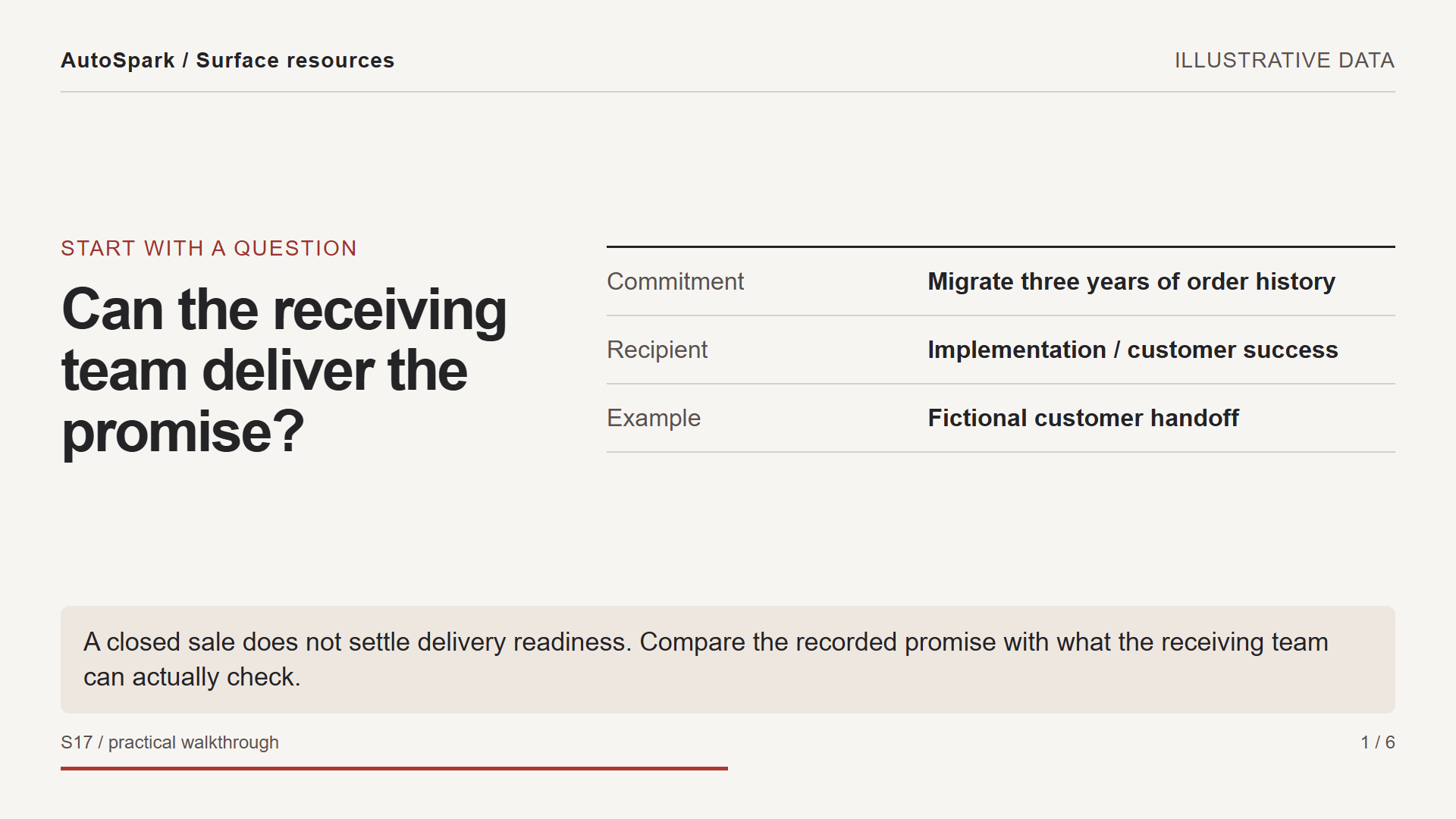
A fictional team marks a sale won while the promised historical data is still missing. Customer success receives the account name but cannot tell what the customer was promised. A new required field alone would not establish whether its contents are correct.
| ID | Required behaviour | Acceptance example | Open decision |
|---|---|---|---|
| CRM-01 | Link each delivery commitment to its source and owner | Receiver opens the referenced commitment and records whether it is understood | Which source is authoritative if proposal and contract differ? |
| CRM-02 | Show unresolved handoff items separately from accepted ones | A missing data period remains visible with an owner and next check | Who may accept a handoff with this exception? |
| CRM-03 | Record receiver acceptance without changing the sales outcome | Seller can see accepted and returned items in the example | Which roles may change acceptance? |
Do not infer a customer's agreement from an internal salesperson's checkbox. The evidence and decision authority must match the statement being made.
Questions for a CRM discovery meeting
Ask the seller to show a recent handoff and the receiver to show the information they actually used. Compare the two accounts. Then inspect a returned handoff: was information absent, contradictory or inaccessible? Each condition may require different behaviour.
Ask who owns an account during reassignment, how duplicate records are resolved and what happens if a required integration is unavailable. Record access and retention questions for the people authorised to decide them. Avoid specifying permissions from job titles alone.
Use the sales-to-customer-success handoff example to work through commitments. Follow the accepted requirements in the traceability matrix. A separate platform design review should check the chosen implementation against these examples.
Which CRM behaviours and handoff conditions need an explicit decision?
Specify lifecycle behaviour, ownership and handoff exceptions before selecting CRM fields.
Your starting question: Which CRM behaviours and handoff conditions need an explicit decision?
Start by checking
- Define each lifecycle transition.
- Check ownership and unresolved handoff items.
- Test accepted and rejected examples.
Evidence to gather
- Current workflow and configured record examples.
- Commitment sources and receiver requirements.
Not established yet
- The selected platform can implement the design.
- The correct access configuration.