Describe what the evidence can establish
A current-state assessment should join observed records with attributed accounts of the work. Label disagreements and missing information. Its output is a bounded description of what is known, plus the next checks needed for a decision.
Start with one question and a defined scope. “Why do these invoices reach payment late?” is more specific than “assess finance”. State the period, the cases included and how they were selected. A convenient example can illustrate a method without representing the whole operation.
Assessment template
| Field | What to record |
|---|---|
| Question and boundary | Decision to support, included work, period and exclusions |
| Record inventory | Source, coverage, event meaning, access and known gaps |
| Accounts | Who described what, when, and in which context |
| Observed sequence | Events supported by records, with uncertain ordering labelled |
| Discrepancies | Accounts or records that do not agree |
| Possible explanations | Alternatives and the evidence that would distinguish them |
| Next check | Specific record or observation, responsible person and decision it informs |
Keep an explanation in the explanation column even if everyone in the meeting finds it plausible. Repetition of an account does not turn it into an observed event.
Synthetic example: where is the invoice waiting?
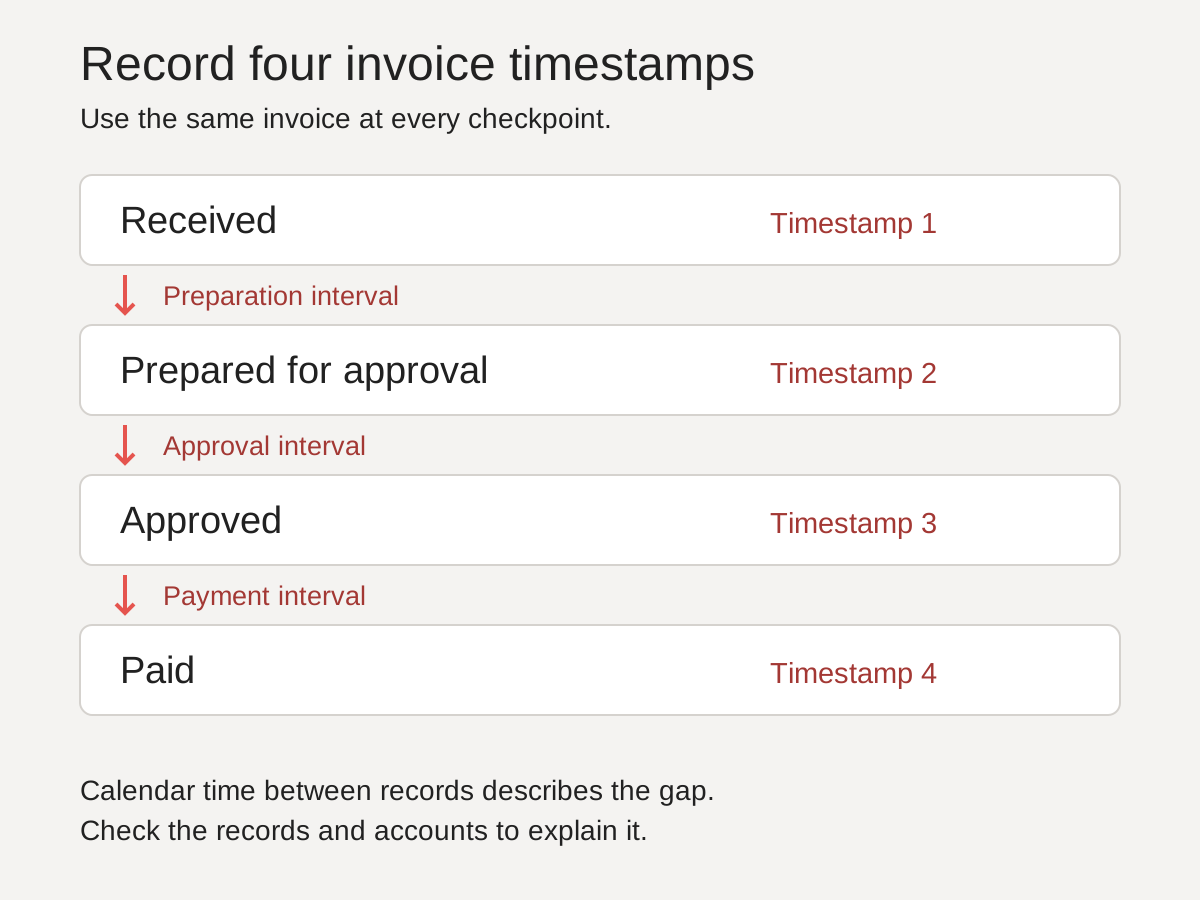
A manager says an invoice was “with approval for a month”. The example record has received, captured, approved and paid dates. A long received-to-captured interval could be consistent with delayed capture, incomplete information, a different meaning of “received”, or missing intermediate records.
| Statement | Classification | Next check |
|---|---|---|
| Received and captured timestamps are 20 calendar days apart | Observation within the synthetic record | Confirm event meanings and timezone handling |
| The approver caused those 20 days | Unsupported explanation | Locate assignment, return and approval-history records |
| Some work may have occurred before capture | Possible explanation | Inspect dated correspondence or earlier system records |
Do not assign the whole elapsed interval to a person or infer active labour from two dates. Compare cases only when their event definitions and selection methods are compatible.
Finish with a decision-ready summary
Write the strongest supported finding in plain language. Follow it with the limitation that could change the decision and a specific next check. If the evidence cannot distinguish two explanations, say what would distinguish them instead of selecting the more convenient story.
The invoice investigation worksheet provides a worked checkpoint comparison. Use this assessment around it to preserve source coverage and alternative explanations. A process map can show the recorded sequence, but a tidy diagram does not resolve an unsupported step.
What does the current evidence establish, and what should we check next?
Describe observed work, attributed accounts and alternative explanations within an explicit boundary.
Your starting question: What does the current evidence establish, and what should we check next?
Start by checking
- Define period and case selection.
- Distinguish observations from explanations.
- Identify evidence that separates alternatives.
Evidence to gather
- Dated records with source coverage.
- Attributed accounts and event definitions.
Not established yet
- A representative population result.
- A proven cause of elapsed time.