Choose a method from the question and the available records
A process map helps describe a sequence of work. Process mining examines recorded execution using event data. An investigation can combine accounts, documents, maps and event analysis to check a particular uncertainty. These approaches can be used together.
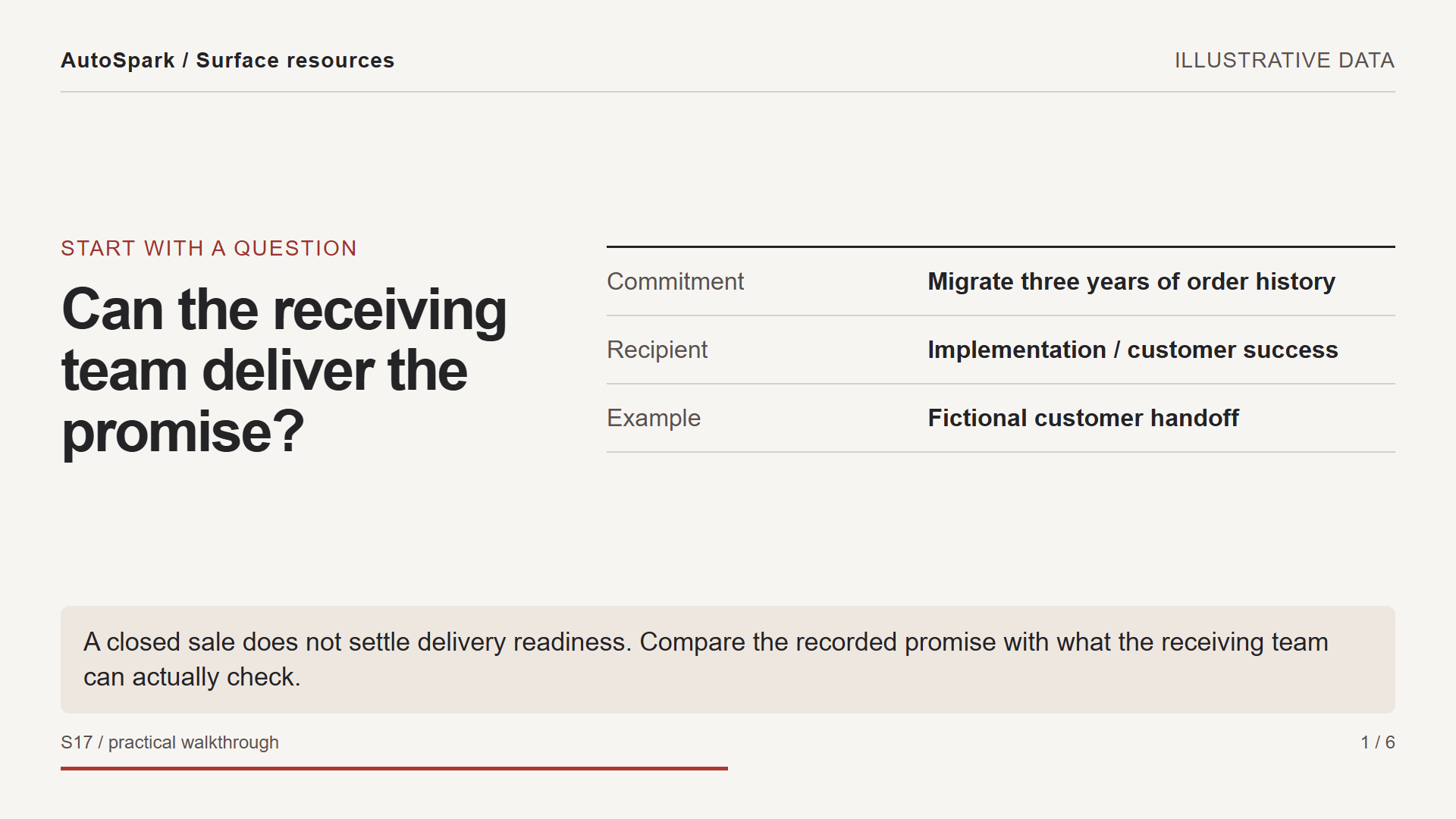
In the synthetic sales handoff, the receiving team has unresolved questions about historical data and promised delivery. A diagram of the intended handoff can help locate the decision, but it cannot show that the promised data exists.
What each approach needs
| Question | Input to inspect | Useful output | What remains uncertain |
|---|---|---|---|
| What steps and decisions do participants describe? | Accounts, current procedures and examples of work | A map with sources attached to the steps | Whether every step occurred as described |
| What sequences appear in recorded execution? | Events with meaningful activity, object or case identity, and ordering information | Patterns in the covered event data | Work omitted from the logging system |
| Does recorded execution conform to a model? | An explicit model and suitable event data | Departures from that model | Whether the model is correct or the departure is harmful |
| Why do two accounts differ on this commitment? | The accounts, their scope and relevant records | A bounded finding or a specific unresolved question | Claims that the available evidence cannot distinguish |
The IEEE Process Mining Manifesto distinguishes discovery, conformance and enhancement. Discovery derives a model from event data; conformance compares a model with recorded execution; enhancement uses event information to extend or improve a model. These are technical categories, not a recommendation that every investigation needs a mining tool.
Keep the object and period consistent
Suppose a team asks whether an order moves from sales to delivery only after the receiving owner accepts it. This is a hypothetical question. First define what counts as an order, an acceptance and the handoff period.
Map the claimed steps and identify who supplied each account. Then inspect whether available records identify the same orders and acceptance events. A timestamp labelled “updated” may represent several kinds of edits. It cannot be treated as acceptance without checking its meaning.
If the log has no acceptance event, record that gap. Ask for the relevant handoff record or a bounded observation. Do not silently substitute the closest available timestamp and report the intended process as measured.
Use a short method decision record
| Field | Record |
|---|---|
| Question | The decision or uncertainty to resolve |
| Unit and period | Which cases, events or objects are included |
| Available evidence | Records and accounts you can inspect |
| Proposed method | Mapping, event analysis, further evidence checks, or a combination |
| Known limit | What this method and evidence cannot establish |
| Next check | The specific missing fact or record, and its owner |
For the hypothetical handoff, a reasonable first route is to map the claimed acceptance step, check event meanings, then examine cases where the records and accounts differ. That sequence is our proposed practice. The outcome might be better logging, a corrected definition, a delivery decision or a reason to investigate further.
Where to go next
Use the handoff template to keep the commitment, receiving owner and acceptance evidence together. If the task is to track what an agreed change must satisfy, use the requirements matrix.
Surface's public explanation describes operational discovery for advisors. This article makes no claim that Surface provides process-mining functions. You can discuss a bounded investigation before choosing a method or product.