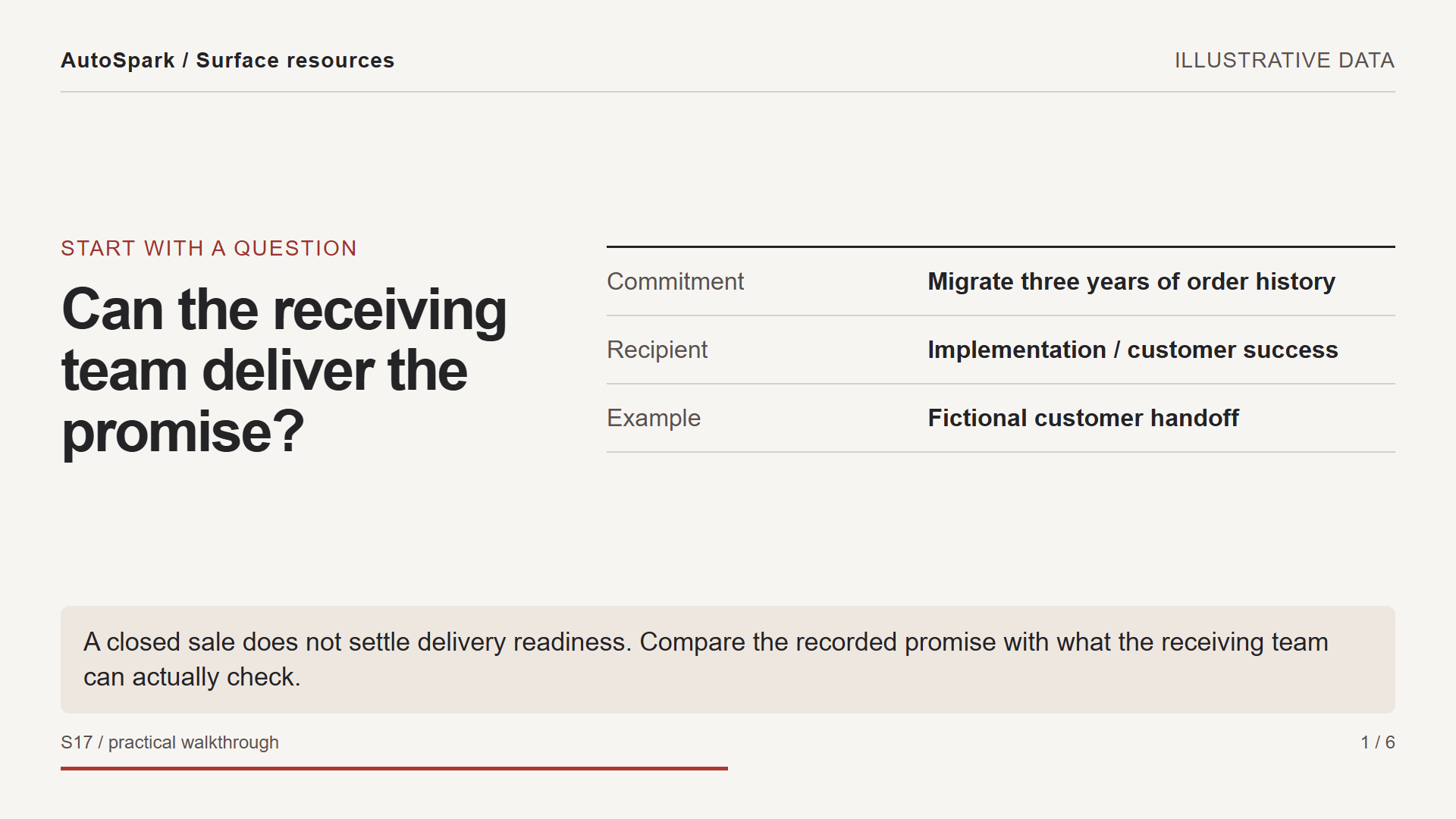
A project handover should identify what the receiver is accepting, the evidence they inspected and the work still unresolved. Record an operating owner and a recovery route for each important exception. A delivery team's completed task list does not itself establish receiver acceptance.
Hand over something the receiver can operate
A project handover should identify what the receiver is accepting, the evidence they inspected and the work still unresolved. Record an operating owner and a recovery route for each important exception. A delivery team's completed task list does not itself establish receiver acceptance.
Use this pack for a change moving into operation. For commitments moving from sales into customer success, use the sales handoff template. The two handoffs can share evidence, but their acceptance decisions differ.
Handover record
| Item | Fill in before the review |
|---|---|
| Delivered scope | Version, included behaviour and exclusions |
| Acceptance evidence | Demonstration or test reference, result and date |
| Receiver | Person accepting the operating responsibility and their authority |
| Operating material | Runbook, permitted access and where current records live |
| Exceptions | Unresolved defect or decision, impact, owner and next action |
| Recovery | How the receiver recognises failure and obtains help |
| Acceptance decision | Accepted, returned, or accepted with explicit conditions |
| First review | Date or event that triggers a check of the handover conditions |
Keep passwords and private customer records out of the handover document. Link to the approved access process and record whether access was demonstrated.
Worked example: a scheduled report
This is a synthetic delivery example. A project team has demonstrated that a weekly report can be generated. The operations receiver has not yet tested the failure notification or confirmed who responds when the source file is absent.
| Evidence | What it establishes | What remains unresolved |
|---|---|---|
| Successful run R-01 using the agreed sample | The demonstrated path produced its expected output | Other inputs and future runs |
| Receiver opened the runbook during review | The receiver could access that version | Whether recovery instructions work |
| Missing-source test not performed | Nothing about recovery yet | Test outcome and response owner |
The receiver returns the recovery item and asks for a missing-source demonstration. They can accept documentation access independently if their process allows partial acceptance. Record precisely which items changed state; do not mark the whole project accepted by implication.
Run the handover meeting
Start with the operating task and ask the receiver to perform it using the supplied material. Inspect an exception as well as the successful path. Record questions against the relevant item, then have the authorised receiver state the decision and any conditions.
After the meeting, preserve the reviewed version and assign each returned item. If a condition changes before release, seek the appropriate revised decision. At the first operating review, compare what happened with the handover assumptions and record any correction without erasing the original decision.
What can the receiver accept, and what remains unresolved?
Record receiver acceptance, operating evidence, unresolved conditions and a first review.
Your starting question: What can the receiver accept, and what remains unresolved?
Start by checking
- Demonstrate the operating task.
- Inspect an exception and recovery route.
- Record the authorised acceptance decision.
Evidence to gather
- Delivered version and runbook.
- Test results and unresolved conditions.
Not established yet
- All operating conditions have been tested.
- The whole project is accepted.