A month-end close checklist should show each activity's evidence, dependency and reviewer decision. Keep missing inputs and unresolved differences visible. Mark a task complete only against the organisation's agreed completion rule; a submitted file and an accepted reconciliation are different states.
A close checklist that shows the unresolved work
A month-end close checklist should show each activity's evidence, dependency and reviewer decision. Keep missing inputs and unresolved differences visible. Mark a task complete only against the organisation's agreed completion rule; a submitted file and an accepted reconciliation are different states.
This is an operational coordination template, not accounting policy or a completeness standard. The responsible finance owner must select the activities and controls appropriate to the organisation. The examples below are synthetic and do not prescribe journal treatment, deadlines or materiality thresholds.
Copy this activity register
| Activity | Required input | Completion evidence | Owner and reviewer | Exception status |
|---|---|---|---|---|
| Gather the period's inputs | Agreed source list and reporting period | Received-input index with gaps shown | Assign both roles | Missing source, next check |
| Reconcile an agreed account | Relevant ledger and supporting records | Reconciliation and explained differences | Assign both roles | Unresolved difference, decision owner |
| Review outstanding approval items | Dated approval records | Reviewed item list and recorded decisions | Assign both roles | Pending, rejected or escalated |
| Review close readiness | Required activities and dependencies | Authorised readiness decision with exceptions | Finance decision owner | Accepted conditions or hold |
Add the planned finish and actual completion time if you need to investigate schedule differences. Define what each timestamp means before comparing periods. Do not fill a missing completion time with today's date and treat it as completed work.
Worked dependency example
In a fictional close, the reconciliation owner receives file A on Monday and file B on Wednesday. The register says “reconciliation started Monday” and “submitted Thursday”. Those timestamps alone do not show three days of active reconciliation work.
Record input-ready time separately from start and submission. Ask whether work proceeded before file B arrived, whether the file was usable, and when the reviewer accepted the result. If no evidence identifies those events, keep the intervals unknown.
| Recorded event | Time in the synthetic example | Interpretation |
|---|---|---|
| File A received | Monday 09:00 | One input arrived |
| File B received | Wednesday 09:00 | Another input arrived; usability still needs confirmation |
| Reconciliation submitted | Thursday 09:00 | Submitted for review, not necessarily accepted |
| Reviewer acceptance | Not recorded | Completion under an acceptance rule remains unknown |
Investigate a late close
Choose a defined set of periods and activities, then inspect the actual dependencies. Separate unavailable inputs from processing and review intervals where records permit. Check whether the activity set changed between periods before comparing totals.
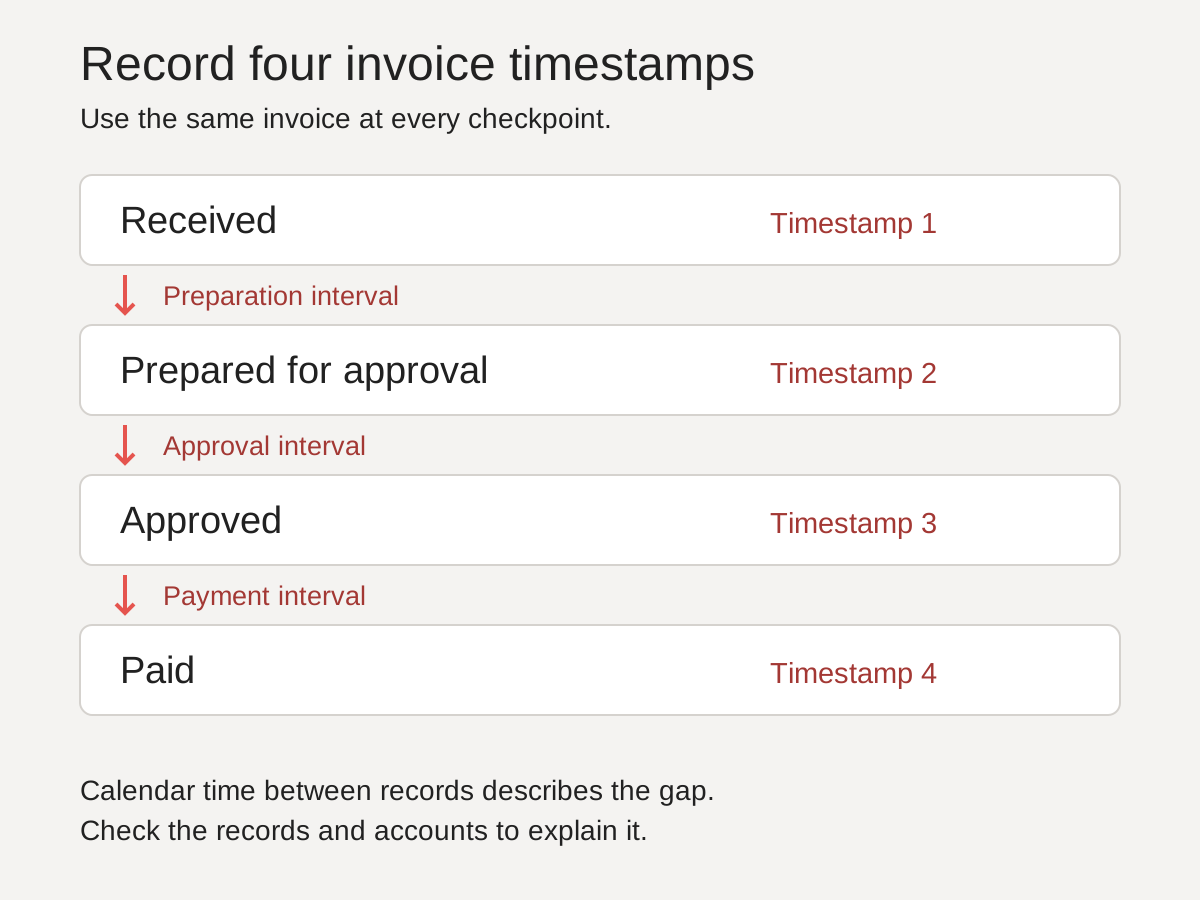
For an approval-specific investigation, use the invoice checkpoint example. Its elapsed-time method can help frame questions, but its invoice events are not a substitute for defining close events. Record the next evidence check before proposing automation or a faster timetable.
Which close dependency is unresolved, and what evidence would settle it?
Coordinate close activities using defined completion evidence and visible unresolved dependencies.
Your starting question: Which close dependency is unresolved, and what evidence would settle it?
Start by checking
- Define received, submitted and accepted events.
- Separate missing inputs from review intervals.
- Keep incomplete activities visible.
Evidence to gather
- Activity register and dated source arrivals.
- Reviewer decisions and unresolved differences.
Not established yet
- The checklist is complete for this organisation.
- Elapsed time is active labour or proven delay.